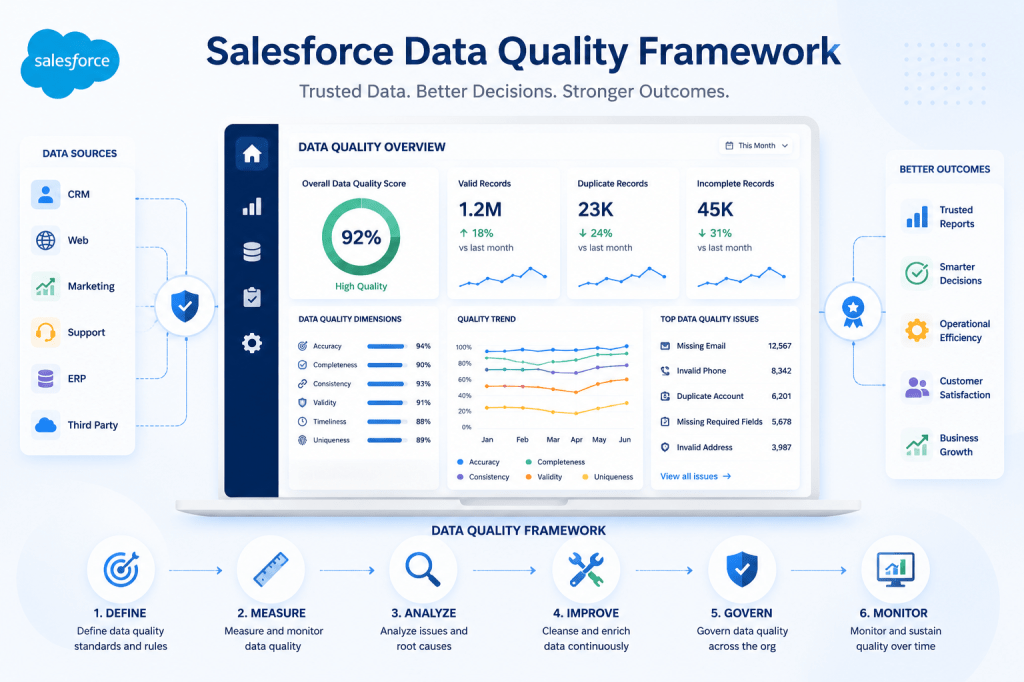
“We need to clean up our data” is one of the most-said and least-finished projects in Salesforce. Someone runs a duplicate report, fixes a few hundred records, and then six months later the org is just as messy.
The reason cleanup projects fail isn’t the cleanup. It’s that nothing changed about how the data gets created and maintained. Data quality is a system, not a sprint. Here’s a framework I’ve seen work.
Layer 1: Prevent
The cheapest data error to fix is the one that never gets created. Most data quality work should happen here.
- Make critical fields required at the page layout and validation rule level. If your win-loss reporting depends on Close Reason, that field has no business being optional.
- Constrain picklists. If reps are typing free-text industry values, you don’t have an Industry field — you have a search problem.
- Validate integrations. Marketing automation, CPQ, ERP integrations are usually the highest-volume sources of bad data. Audit what they’re pushing in and match field types and required values.
- Resist over-engineering. Validation rules that block users from saving without 14 fields filled in produce two outcomes: skipped records or junk values to bypass the rule. Pick the fields that truly matter.
Layer 2: Detect
Some bad data is going to slip through anyway. The goal is to find it before it compounds.
- Build a hygiene dashboard: missing critical fields, opportunities past close date, accounts without owners, duplicate contacts.
- Use duplicate rules in alert mode (not block mode) so reps can see and resolve duplicates at creation, but the system isn’t fighting them.
- Schedule weekly hygiene reports directly to record owners. Don’t send them to admins — send them to the people who can actually fix the records.
Layer 3: Correct
Cleanup needs to happen on a rhythm, not a panic. The pattern that works: 30 minutes per week per record owner, focused on a small queue of records flagged by the hygiene reports.
For larger cleanups (de-duping, mass-updating addresses, fixing legacy records), schedule them as discrete projects with clear scope. “Fix all the data” is a project that never ends. “Merge duplicate accounts created in 2023” has a finish line.
Layer 4: Monitor
What gets measured gets managed. Build a single dashboard tile or scorecard that quantifies data quality — even a simple percentage of accounts with all critical fields filled in. Put it in the executive dashboard. Talk about it in the same meeting where you talk about pipeline.
The most effective change I’ve seen at any company: data quality became part of the sales manager’s monthly performance review. Not punitive — just visible. Within a quarter, hygiene improved across the board.
Where to start
If you tackle this in any order other than 1 → 4, you’ll be back to square one inside a year. Start by closing the front door (Layer 1). Then build detection (Layer 2). Then run cleanups (Layer 3). Then make it visible (Layer 4). Anything else is a cleanup, not a system.


Leave a Reply